
Ontario Municipal Election Results
Ontario’s municipalities went to the polls on October 26 to elect mayors, councillors and school board trustees for four-year terms that begin November 15. The vote was the first full municipal cycle since the province extended strong mayor powers beyond Toronto and Ottawa to more than 200 municipalities. It followed a provincial election in which affordability, housing supply and the cost of local services dominated, and those same issues decided most of Monday’s mayoral races. In Toronto, a race the polls called close ended in a majority. In Mississauga and Hamilton the incumbents lost outright, and in Ottawa the incumbent held on with a reduced share. Beyond the three largest cities, sitting mayors also lost in Oakville, Milton, Halton Hills, Windsor, Kingston, Waterloo and Niagara Falls. New councils will set their first budgets in early 2027, and their decisions on zoning, development charges and service levels will govern every file that needs municipal approval through 2030.
Toronto Mayoral Vote
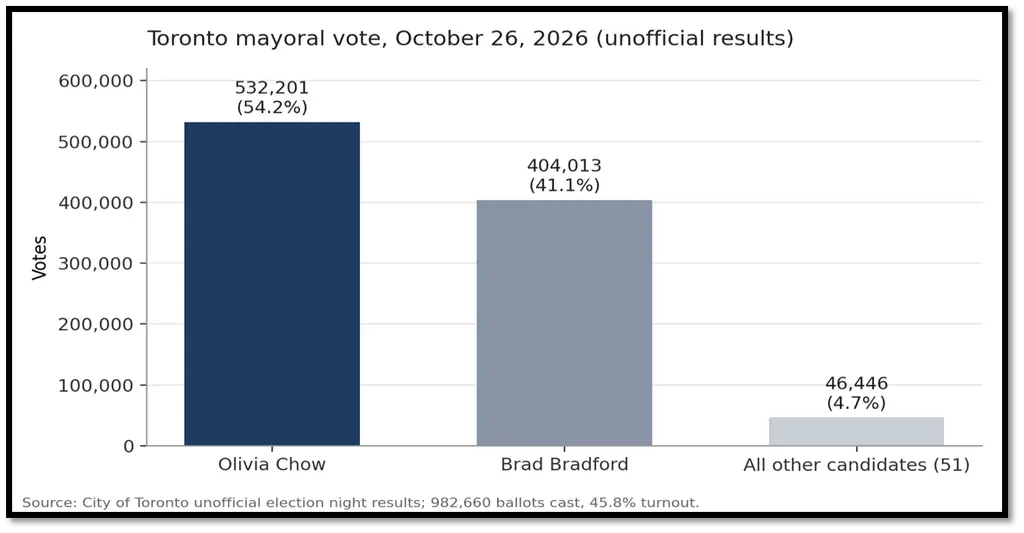
Olivia Chow won 532,201 votes, 54.2 per cent of the 982,660 ballots cast, against 404,013 (41.1 per cent) for Brad Bradford, a margin of 128,188. The remaining 51 candidates shared 46,446 votes. Braeden Chow, whose name the mayor’s campaign worried would confuse voters, took 8,102, and Chris Alexander, who withdrew on the first day of advance voting but remained on the ballot, took 3,550. Chow’s total is the largest any mayoral candidate in Toronto has recorded since amalgamation in 1998. It is nearly double the 269,372 she received in the 2023 byelection, when she won with 37 per cent in a crowded field. Polling in the final week had Bradford narrowly ahead in two surveys and Chow ahead in two others; the result was a 13-point margin. Chow carried 19 of 25 wards, including every Scarborough ward and the City of Toronto core, where her share ran above 65 per cent in Parkdale-High Park, Davenport, Spadina-Fort York, Toronto Centre and Toronto-Danforth. Bradford’s six wards were Etobicoke Centre, Etobicoke-Lakeshore, York Centre, Eglinton-Lawrence, Don Valley West and Willowdale. Having given up his Beaches-East York seat to run, he leaves city hall.
Toronto City Council: Support for the Mayor Grows
Eighteen of Toronto’s 25 councillors return, and the seven new members tilt council further toward the mayor. Candidates who had endorsed the mayor’s agenda won all four open seats. Diana Chan McNally won Parkdale-High Park, and Mike Layton, Chow’s stepson, returns to University-Rosedale four years after stepping down. Former school trustee Sara Ehrhardt won Toronto-Danforth, and former Liberal Member of Parliament (MP) Nate Erskine-Smith won Bradford’s old seat of Beaches-East York. Three incumbents lost. Frances Nunziata, on council since 1997 and its longest-serving member, finished third in York South-Weston behind tenant organizer Chiara Padovani, who had lost to her by 94 votes in 2022. Chris Moise lost Toronto Centre to Curran Stikuts, and Jamaal Myers, who chaired the Toronto Transit Commission, lost Scarborough North to former MP Shaun Chen. Chow has again said she will not use the strong mayor powers the province gave the office, and with this council she has less reason to need them. A larger majority also means the budget decisions ahead will be hers to own.
Mississauga and Hamilton Change Hands, Ottawa Holds
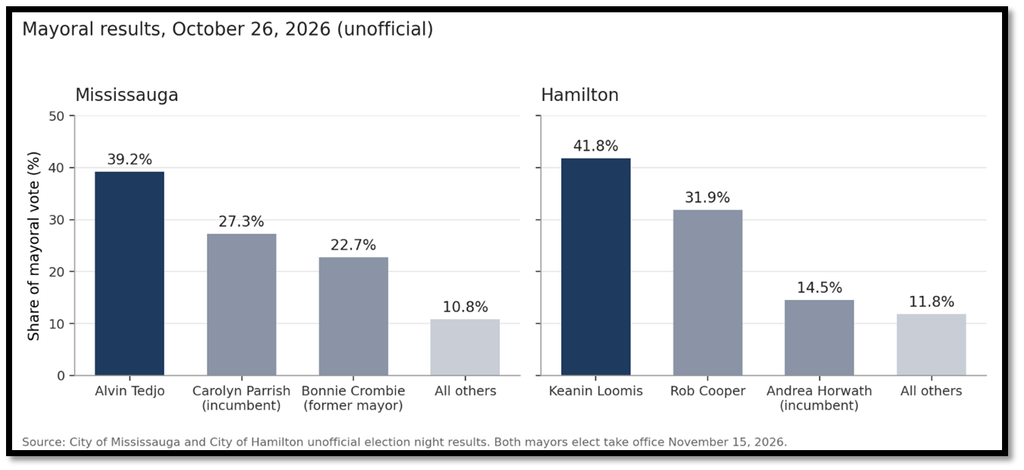
Mississauga was billed as a contest between the sitting mayor and the one she replaced. Bonnie Crombie resigned the office in January 2024 to lead the Ontario Liberals, Carolyn Parrish won the June 2024 byelection to replace her with 31 per cent, and both ran in October. Alvin Tedjo, the Ward 2 councillor, finished second to Parrish in 2024 and polled at 12 per cent in August. He won with 74,479 votes (39.2 per cent) to Parrish’s 51,853 (27.3 per cent) and Crombie’s 43,191 (22.7 per cent). In Hamilton, Keanin Loomis, the former Hamilton Chamber of Commerce president who lost to Andrea Horwath by 1,663 votes in 2022, won with 41.8 per cent. Ward 8 councillor Rob Cooper took 31.9 per cent and Horwath 14.5 per cent. Hamilton also elected eight new councillors, and Brampton returned Patrick Brown.
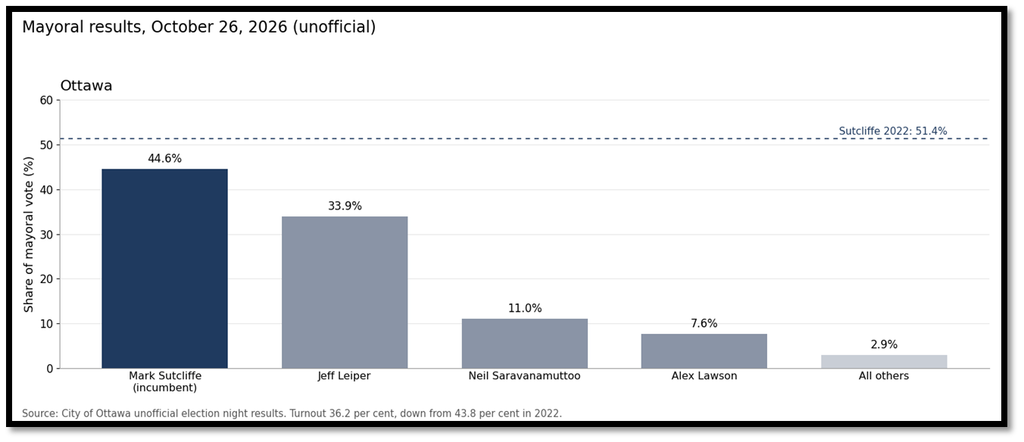
Ottawa kept its mayor on a smaller mandate. Mark Sutcliffe won a second term with 139,354 votes (44.6 per cent), a margin of 33,535 over Jeff Leiper, the Kitchissippi councillor who gave up his seat to run and took 105,819 (33.9 per cent). Neil Saravanamuttoo took 34,463 (11.0 per cent) and Alex Lawson 23,605 (7.6 per cent), and the other ten candidates shared under 3 per cent between them. CTV News and the Canadian Broadcasting Corporation (CBC) called the race before 9 p.m. Sutcliffe’s share is down from 51.4 per cent in 2022, and fewer people voted: 314,393 of 866,685 eligible voters cast a mayoral ballot, 36.2 per cent, against 316,254 four years ago. He ran on affordability, transit and public safety, and has said since the vote that a $95 monthly transit pass will be in the 2027 budget. Two councillors, in River and Rideau-Jock, were acclaimed, and most of council returns with him.
Incumbents Fall Across Halton, Niagara and the Mid-Sized Cities
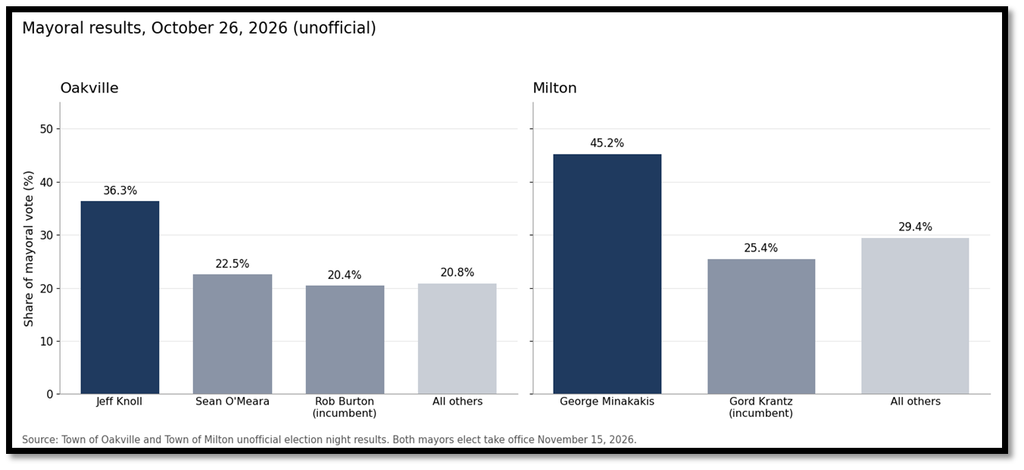
Halton Region replaced three of its four mayors. In Milton, Gord Krantz, mayor since 1980 and on council since 1965, lost his bid for a 15th term to Ward 1 councillor George Minakakis, who took 20,262 votes (45.2 per cent) to Krantz’s 11,398 (25.4 per cent). Krantz had held the office in 2022 by roughly 1,000 votes, and turnout this time rose about 10 points to 39 per cent. Minakakis won his council seat in a 2025 byelection and ran on keeping infrastructure and services ahead of growth in one of the fastest-growing municipalities in the country. In Oakville, Rob Burton, mayor since 2006, finished third. Ward 5 councillor Jeff Knoll, on council since 2000 and chair of the Halton police board, won with 21,866 votes (36.3 per cent) against 13,567 (22.5 per cent) for Ward 1 councillor Sean O’Meara. Burton took 12,254 (20.4 per cent), four years after surviving 2022 by 886 votes. Knoll used his victory speech to say his first act would be telling Queen’s Park that the town is not negotiating on the Midtown redevelopment, and he has committed to a municipal lobbyist registry. Six of Oakville’s councillors are new. In Halton Hills, councillor Jason Brass defeated incumbent Ann Lawlor with 55.7 per cent to her 30.7. That leaves Burlington’s Marianne Meed Ward, returned to a third term with 44.3 per cent, as the region’s only incumbent mayor on a regional council whose chair the province now appoints.
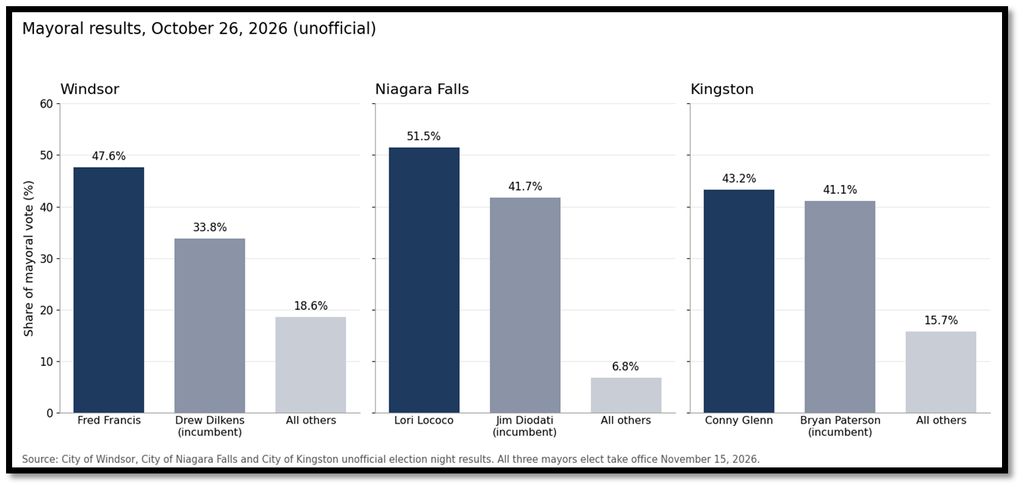
The pattern repeated outside the Greater Toronto Area. Windsor’s Drew Dilkens lost a bid for a fourth term to former Ward 1 councillor Fred Francis, 47.6 per cent to 33.8, on a platform of lower spending, downtown renewal and a pledge not to use strong mayor powers. In Niagara Falls, four-term mayor Jim Diodati lost to councillor Lori Lococo, 51.5 per cent to 41.7. The incumbents in Fort Erie and Port Colborne lost the same night, so Niagara’s regional council of 12 mayors under a provincially appointed chair will seat three new members. Waterloo’s Dorothy McCabe, who won in 2022 by 331 votes, lost the rematch with Shannon Weber by 6,379. Kitchener’s Berry Vrbanovic was the only mayor in Waterloo Region to be re-elected, with his share down from 80 per cent to 55. In Kingston, Conny Glenn ended Bryan Paterson’s 12 years in office by 793 votes, 43.2 per cent to 41.1. Clarington, Timmins and Tecumseh also replaced sitting mayors, Guelph elected Leanne Caron to succeed Cam Guthrie, who did not run, and Cambridge and Brantford have new mayors as well. The incumbents who held did so from different positions: Frank Scarpitti in Markham (72 per cent), David West in Richmond Hill (84 per cent) and Alex Nuttall in Barrie (67 per cent) all grew their share, while London’s Josh Morgan was returned with 45 per cent, down from 66 in 2022.
The Cycle Turned on Incumbent Losses and Uneven Turnout
At least two dozen Ontario municipalities changed mayors on Monday, and the defeats reached offices that had not been seriously contested in a generation. A post-election analysis by TVOntario (TVO) called the string of outright incumbent losses a break with precedent, and the losses extended past the cities above to Belleville, Haldimand County, Hearst and West Nipissing. Pollster Nik Nanos read the night as a warning shot from voters worried about traffic, safety, homelessness, housing costs and property taxes. Hamilton and Windsor, the two Ontario cities most exposed to American tariffs, both removed their mayors. The turnover did not come from retirements: the Association of Municipalities of Ontario (AMO) counts 624 incumbents who did not run this cycle, fewer than the 692 who stepped aside in 2022, while 2,161 sought re-election for 2,800 seats. The result fits a month in which Quebec voters ended eight years of Coalition Avenir Québec government and British Columbia voters removed the New Democratic Party (NDP). In Ontario, Toronto, Ottawa and Brampton were the only cities among the province’s five largest to keep their mayors, and Markham, Richmond Hill, Kitchener, Burlington, Barrie, London and Sudbury also returned incumbents.
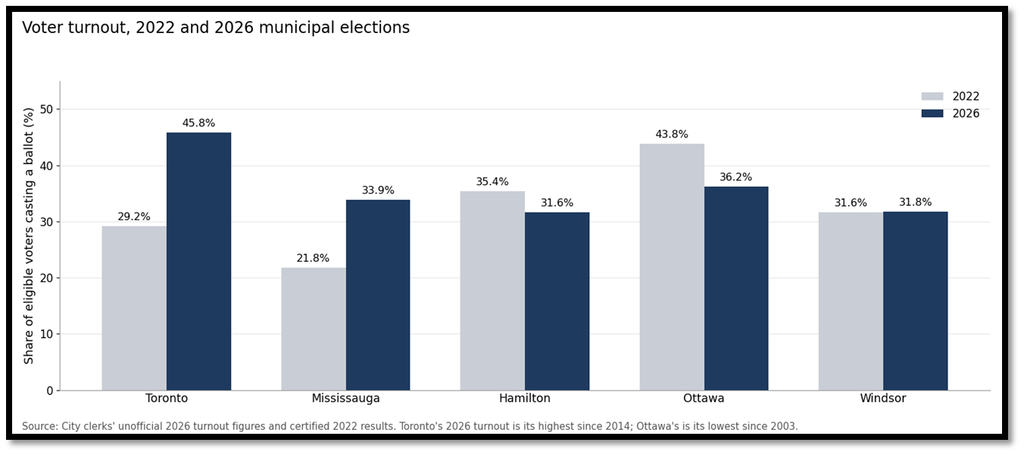
Turnout rose where the outcome was in doubt and fell or held where it was not. Toronto counted 982,660 ballots, 45.8 per cent of eligible voters and its highest participation since 2014, after a 2022 election that drew 29.2 per cent. Advance polls accounted for 222,550 of those ballots, 72 per cent more than in the 2023 byelection. Mississauga rose from 21.8 per cent to 33.9 on the strength of a three-way race. Ottawa moved the other way, falling to 36.2 per cent from 43.8, its lowest turnout since 2003. Hamilton fell from 35.4 per cent to 31.6 even as its mayor lost, and Windsor was flat at 31.8. The cities that changed mayors did so on ordinary turnout, and the new mandates rest on roughly a third of eligible voters.
Fewer seats went uncontested than in 2022. AMO’s count shows 400 candidates acclaimed in 2026 against 548 in 2022, 104 heads of council acclaimed against 139, and 19 councils acclaimed in full against 32. The candidate pool grew to 6,663 from 6,306, and 32 per cent of candidates were women, up from 31 per cent in 2022 and 27 per cent in 2018. Two-thirds of municipalities, 272 in all, offered internet voting, alone or alongside paper ballots, up from 52 per cent four years ago, and 87 ran paper-only ballots. AMO’s low candidature measure, which flags municipalities where positions were acclaimed or drew no more than two candidates, still covers 213 of the 395 municipalities that held a vote. The competitive picture in this note is a large-city phenomenon, and for files in rural Ontario the councils that matter in 2027 are largely the ones that mattered in 2026.
What the Results Mean for Government Relations
The common thread across the Greater Toronto and Hamilton Area is property tax, and Toronto, Mississauga and Hamilton resolved it differently. Toronto returned the mayor who raised taxes 18.5 per cent over three budgets: 9.5 per cent in 2024, 6.9 per cent in 2025 and 2.2 per cent in 2026. She won on a pledge to hold future increases at or around inflation, which ran at 3.1 per cent in September. Mississauga elected a candidate promising a two-year residential freeze, a hiring freeze and a budget tabled within his first 100 days, and Hamilton elected one who campaigned on getting taxes under control. Chow’s pledge is made against the tightest fiscal position of the three. The 2023 deal with the province expires this year. Under it, Ontario took over the Gardiner Expressway and Don Valley Parkway and provided $1.2 billion in operating funding for transit and shelters, and the city dropped its opposition to the Ontario Place redevelopment. The city is projecting a 2027 shortfall of roughly $1.1 billion, with transit ridership still below 2019 levels and a softening housing market squeezing land transfer tax revenue. Her platform adds a weekly transit fare cap, free school lunches and 10,000 rental starts in 2027 to that ledger. Chow said Tuesday she had already exchanged texts with the premier about a renewed deal, and the terms of that agreement, more than any council vote, will decide what the 2027 budget looks like.
Mississauga and Hamilton face the opposite problem: new mayors with mandates for change and little time to show it. Tedjo and Loomis take office on November 15, and both hold the strong mayor powers extended to their cities in 2023. Both also arrive with councils that turned over. Tedjo has said his first act will be a budget built with council inside 100 days, with housing next: he has proposed a city-owned housing corporation to build on underused land. He has also signalled faster permitting for small business and, with Mississauga’s moratorium on large data centres still in place, opposition to approving new ones. Loomis ran on public safety, homelessness, road repair, better connections between Hamilton Street Railway buses, the light rail transit (LRT) line and Government of Ontario (GO) Transit, and support for the city’s steelworkers against American tariffs. Senior staff who served Parrish and Horwath will report to mayors who campaigned against the direction of the last four years. The committee chairs, senior appointments and first budgets settled before the end of February will hold for most of the term. In Ottawa, as in Toronto, there is no such reset. Sutcliffe returns with most of council and the committee structure carries over, so the 2027 budget is already taking shape around his fair-share case to the other orders of government and the $95 transit pass he has promised.
The smaller cities present the same opening on a different scale. Knoll, Minakakis, Francis, Lococo, Weber and Glenn each take office on November 15 with strong mayor powers and councils that turned over alongside them. Each has a first budget to table in early 2027 against a campaign commitment on taxes or spending. Knoll’s position on Midtown puts Oakville in direct conflict with the province on housing from the first day. Lococo won on the line that Niagara Falls has a spending problem rather than a revenue problem, and Francis has said he will not use the powers at all. Milton and Oakville also carry the heaviest growth obligations in Halton, and both new mayors ran on holding the pace of that growth. Senior staff in each of these cities will spend the next four months re-establishing direction with a new office. The window to get in front of a file before committee chairs and first budgets are set is the same November to February period that applies in Mississauga and Hamilton.
Toronto and Ottawa have settled decision-making structures, and Toronto’s constraint is fiscal. Mississauga, Hamilton and the smaller cities that changed mayors are open on both counts until their first budgets pass in early 2027. Integrated Strategic Partners’ Ontario team is following each transition and will circulate further notes as the new councils take shape.